What is a full gasket set and what does it contain?
A full gasket set supplies every sealing element needed in an engine overhaul in one kit. What it contains and why it is worth choosing.
Opublikowano:
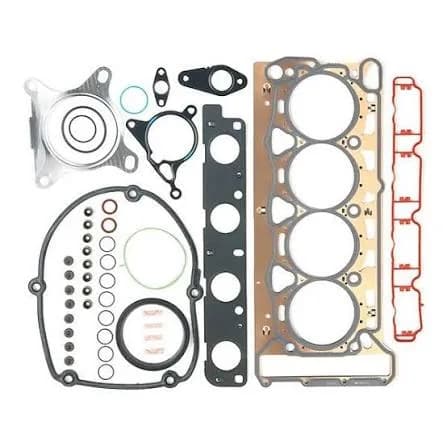
An engine overhaul is not only about replacing worn parts; restoring the engine's sealing is one of the most critical steps of the job. This is where a full gasket set stands out as one of the most practical and reliable solutions for workshops and individual owners alike. In this article we explain what a full gasket set is, which parts it contains, when it should be replaced and how to choose the right product.
What is a full gasket set?
A full gasket set (also called an overhaul kit or complete gasket kit) gathers, in a single box and specific to an engine model, all the gaskets that are removed during an engine repair or overhaul and must not be reused. Because the set is prepared for a particular engine code, displacement and number of cylinders, every part is made to the dimensions of that engine.
An engine has dozens of sealing points that keep combustion pressure, coolant and engine oil apart, and each depends on a single gasket doing its job. A full set lets you renew all of them at once, which minimises the risk of leaks after the overhaul.
Which parts are in the set?
The contents vary by engine type, but generally the following parts are included:
- Cylinder head gasket: separates combustion pressure, coolant and oil passages between the block and the head
- Valve stem seals: prevent oil from passing along the valve stems into the combustion chamber
- Rocker (valve) cover gasket: stops oil leaking from the valve cover
- Intake and exhaust manifold gaskets: seal the air intake and exhaust gas outlet
- Oil sump gasket: seals the oil pan to the engine block
- Oil seals and front/rear crankshaft seals: prevent oil escaping at shaft outlets
- Additional rings, O-rings and water pump/thermostat gaskets: included depending on the engine model
The exact contents can differ from product to product, so we recommend checking the engine code and OEM reference numbers on the product page before ordering.
When should a full gasket set be replaced?
Gasket failures usually develop gradually rather than suddenly. If you notice one or more of the signs below, the engine's sealing elements should be inspected:
- Continuous white, sweet-smelling smoke from the exhaust
- Coolant level dropping for no apparent reason and the engine overheating
- A brown, frothy mixture on the dipstick or under the oil filler cap
- Oil or coolant leaks around the block, head or sump
- Rough idle, vibration and loss of power
- An engine overhaul, head resurfacing or piston/ring replacement
Renewing the gaskets whenever an engine is overhauled or the cylinder head is removed is a practice manufacturers generally recommend. A used gasket has lost its compression properties and cannot guarantee a seal when refitted.
Individual gaskets or a full set?
Replacing only the cylinder head gasket may look sufficient in some cases, but once the engine is open you have access to the other gaskets as well. Taking it apart again means extra labour cost and lost time. The main advantages of choosing a full set are:
- Guaranteed fit: all parts are made for the same engine, so there are no dimension or thickness mismatches
- Time saving: everything you need arrives in one box instead of searching for parts one by one
- Cost advantage: usually more economical than buying the parts separately
- Lower risk of a second teardown: no need to reopen the engine because a gasket was forgotten
- Simpler traceability: one manufacturer and one reference number simplify supply and warranty
How to choose the right full gasket set
Follow these steps in order to reach the right product:
- Confirm the vehicle make, model, year and engine code from the registration or service booklet
- Check engine capacity and number of cylinders; one model may offer several engines
- Verify the fuel type (petrol, diesel, LPG) and emission class (for example Euro 4, Euro 5, Euro 6)
- Match the OEM number on the old gasket or part with the reference numbers on the product page
- If you are unsure, send us your vehicle details and ask which product fits
With the vehicle selector on our website you can list compatible products by choosing make, model and engine, or you can type the OEM number into the search box.
Points to watch during installation
Even the best gasket set cannot perform as expected if it is installed incorrectly. Before and during assembly we recommend following these rules:
- Clean the block and head surfaces completely of old gasket residue, oil and dirt
- Check surface flatness with a straightedge and feeler gauge; a warped head breaks the seal
- Place gaskets according to the direction and position marks on them
- Tighten the bolts gradually in the sequence and to the torque values specified by the manufacturer
- Do not use extra liquid gasket or adhesive where it is not required
- After assembly, check for leaks, overheating and oil pressure at first start-up
Torque values, tightening sequence and whether bolts can be reused vary by engine manufacturer. Always refer to the vehicle's workshop manual for these figures.
The Yaman Conta standard
At Yaman Conta Endüstri ve Dış Ticaret A.Ş. we have produced gaskets for passenger car, commercial vehicle, tractor and construction machinery engines for more than 50 years. We carry out tooling, cutting and assembly under one roof, and under our ISO 9001:2015 certified quality management system every product passes 100% final inspection. We export to many countries and supply the assembly industry on a regular basis. The full gasket sets in our catalogue are available for Fiat, Renault, Tofaş, Opel, Peugeot, Lada, Massey Ferguson, Perkins and Škoda engines.
Frequently asked questions
Is a full gasket set the same as a cylinder head gasket? No. The cylinder head gasket is only one of the most important parts of a full set. A full set also contains the engine's other sealing elements.
Can I fit a full gasket set myself? Removing and reassembling an engine requires special equipment, a torque wrench and technical knowledge. We therefore recommend that the work be done by a qualified service or workshop.
Can I reuse the old gasket? No. A compressed gasket has lost its elasticity, so the risk of leaks is high if it is reused.
How do I find the full gasket set for my vehicle? Type your engine code and OEM number into the search box on our site or use the vehicle selector. If you cannot find it, contact us and we will find the right product for you.
Conclusion
A full gasket set is the safest way to fully restore sealing during an engine overhaul. With the correct engine code, an OEM match and proper installation you protect the life and performance of your engine. If you need help choosing a product, our team will be glad to assist. All brands and numbers on the site are for reference only.